How to Calculate AMR Deployment ROI? Exploring the Payback Period for Logistics Automation
For business owners and production managers considering factory automation and warehouse innovation, the questions they ask right before implementation ultimately boil down to one:
“Will we actually recover our investment if we adopt Autonomous Mobile Robots (AMRs)?”
As securing labor becomes increasingly difficult and labor costs rapidly rise, AMRs (Autonomous Mobile Robots) are recognized not as simple equipment purchases, but as critical investments to simultaneously boost productivity and operational efficiency. However, making an actual implementation decision requires an objective analysis of AMR Return on Investment (ROI), rather than vague expectations. In this article, we will examine the core factors you must check when calculating the payback period for logistics automation in manufacturing and warehouse environments.
3 Core Metrics Determining Logistics Robot ROI
1. Labor Efficiency and Resource Realignment
This is the most intuitive benefit. By reassigning workers who were previously tied up in repetitive, manual material transport tasks to higher-value core processes (such as inspection, packaging, and quality control), you can elevate overall operational efficiency.
- Number of existing transport workers and the proportion of labor costs
- Work shifts and whether day/night rotation is operated
- Increase in production value per process through labor realignment
2. Productivity Gains and Throughput Increase
Autonomous mobile robots operate at a consistent performance level 24/7, unaffected by worker fatigue or skill variance. In manufacturing plants and logistics centers, the following quantitative effects can be expected:
- Minimization of material waiting times and bottlenecks between processes
- Increased line utilization rate due to stabilized, real-time material supply
- Noticeable increase in Units Per Hour (UPH) and total daily throughput (Throughput)
3. Minimization of Initial Infrastructure Setup Costs
Legacy Automated Guided Vehicle (AGV) systems required significant initial costs due to civil works like installing floor markers or burying magnetic tape. In contrast, modern AI-driven autonomous AMRs utilize advanced environment recognition technology to seamlessly integrate into existing production environments with 100% layout retention. Therefore, the following items must be comprehensively reviewed during total budget estimation to eliminate cost errors:
- Hardware and system installation costs
- Annual consumables and maintenance costs
- Cost of integrating in-factory equipment and fleet management software
FAQ: How Long Does It Usually Take to Recover the Investment for AMR Deployment??
Q. What is the actual investment payback period when deploying autonomous mobile robots in a manufacturing plant?
A. The payback period varies depending on factory size, operating hours, number of workers, and the number of robots deployed. Generally, in manufacturing and logistics automation projects, ROI is analyzed by combining labor cost savings with productivity enhancements. Therefore, calculating the payback period based on actual on-site data is the most accurate approach. Checking the expected cost savings through a pre-deployment ROI simulation is highly recommended.
How Many AMRs Does Our Factory Actually Need?
To calculate the exact total investment cost and payback period, determining the optimal number of robots for your factory environment is the first step. The following real-world data points directly impact the fleet size calculation:
- Daily target material transport cycles and hourly payload volume
- Average travel distance and speed from origin to destination
- Number of processes and integration with legacy factory systems (MES, elevators, etc.)
Because the initial budget structure shifts dramatically based on the required fleet size, a preliminary analysis through expert interviews or simulations prior to deployment is essential.
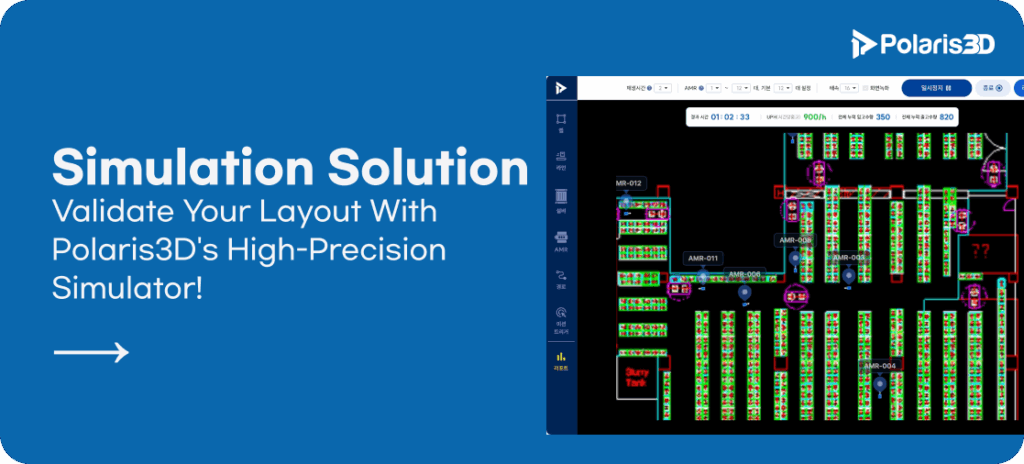
Easily Estimate with the Polaris3D AMR ROI Calculator
More important than a thousand words is a report based on your factory’s actual data. Polaris3D provides a custom AMR ROI calculator for executives and management teams reviewing manufacturing and logistics automation. By entering minimal metrics—such as current on-site headcount, average daily operating hours, and expected deployment size—you can easily check your estimated investment costs and long-term savings scale in just 10 seconds without dealing with complex formulas.
The Core Cost Driver: Proprietary, Locally-Engineered AMR Solutions
The true ROI of logistics automation is not decided solely by the upfront robot purchase price. This is because post-deployment maintenance response speeds, continuous software updates, and the flexibility of on-site customization dictate the Total Cost of Ownership (TCO). Polaris3D directly develops and mass-produces autonomous AMRs (SMAR) and AI robot control platforms based on its in-house R&D and advanced domestic production infrastructure. With zero reliance on outsourced technology or imported components, we have significantly lowered upfront deployment costs. Furthermore, we secure long-term investment returns for enterprises through rapid local maintenance support that prevents factory downtime risks.
Conclusion
AMR ROI goes beyond a simple hardware price comparison; it requires an organic, combined analysis of labor cost savings, process productivity gains, and long-term operational efficiency improvements. To secure a stable and rapid payback period, it is best to conduct a thorough analysis based on actual operating data with a partner who deeply understands the manufacturing landscape. Taking the first step toward smart automation by utilizing an online ROI calculator for an initial simulation is highly recommended.